


Most email marketing tool comparisons are outdated, biased, or written by individuals who have never used the products in real-life scenarios.
This Brevo vs Mailchimp comparison examines pricing, CRM capabilities, and real-world use cases as of 2026.
Quick Overview: Brevo (formerly Sendinblue) vs Mailchimp
Brevo vs Mailchimp pricing: what you actually pay as you grow
While both tools target similar use cases, Brevo and Mailchimp follow fundamentally different pricing models.
Brevo is primarily priced based on email send volume, and its Free plan includes 300 email sends per day (the limit resets daily and doesn’t roll over). This model is often cost-efficient when your contact list grows faster than how often you email it.
In comparison, Mailchimp pricing is primarily driven by the number of contacts and the plan tier you select. That means costs can climb as your list grows, even if you don’t send frequently. Additionally, Mailchimp’s free plan limits have been tightening, so you should double-check the current caps before building your workflow around them.
In practice, if you expect list growth + segmented audiences, Brevo tends to stay more predictable. If your priority is staying within Mailchimp’s ecosystem and you’re willing to pay more as your contacts scale, Mailchimp can still make sense.
Brevo vs Mailchimp — Pricing comparison
Scenario: 1 bulk email per month
Assumption: Low sending frequency, list growth over time
Currency: USD (approx.)
Source: Public pricing pages (2026)
| Contacts (1 email/month) | Brevo (email-volume pricing) | Mailchimp (contact-based pricing) |
|---|---|---|
| Up to 500 | Free (300 emails/day) | ~$13 |
| Up to 1,500 | ~$17 (Standard plan) | ~$26 |
| Up to 2,500 | ~$17–$29 | ~$45 |
| Up to 5,000 | ~$29 | ~$75 |
| Up to 10,000 | ~$29 | ~$110 |
| Up to 20,000 | ~$29 | ~$230 |
| Up to 40,000 | ~$39 | ~$340 |
| Up to 60,000 | ~$55 | ~$630 |
| Up to 100,000 | ~$69 | ~$800+ |
You can test Brevo for free (up to 300 emails per day) to see if it fits your workflow.
How to interpret this table
This table assumes a very low sending frequency (one bulk campaign per month). Under this scenario, Brevo pricing remains relatively flat because costs are driven by email volume, not contact storage.
Mailchimp pricing, by contrast, scales directly with list size, which explains why costs increase steadily even when email volume remains minimal.
Once sending volume approaches or exceeds 1 million emails per month, Brevo pricing shifts to the Professional plan, where costs increase significantly, starting at $445 — similar to other enterprise-grade platforms.
Prices shown are indicative and may vary by region, billing cycle, and feature add-ons.
Automation & CRM Capabilities: How Far You Can Go Without Workarounds
Pricing alone doesn’t tell the whole story. The real difference between Brevo and Mailchimp often appears once you start building automation workflows and managing contacts beyond basic newsletters.
Although both platforms offer automation features, they are designed with very different assumptions in mind.
Brevo’s shift from email marketing tool to CRM platform
Since 2023, Brevo has increasingly positioned itself not just as an email marketing platform but as a CRM-first solution. This strategic shift was formalized through its rebranding from Sendinblue to Brevo, a move clearly aimed at distancing the product from an email-only perception.
Rather than focusing solely on campaigns, Brevo’s product direction has expanded toward contact management, lifecycle automation, and sales workflows. The CRM layer is presented as a central component of the platform, with features such as deal pipelines, contact timelines, and automation tied to sales and marketing activities.
This positioning suggests a broader ambition: serving as a core customer platform rather than a standalone email tool. Brevo’s emphasis on consolidating CRM, automation, and messaging under one interface aligns with a broader industry trend toward reducing tool fragmentation and dependency on external CRMs.
In practice, this helps explain why Brevo’s automation feels more structurally integrated and lifecycle-oriented compared to tools that remain primarily campaign-centric.
Mailchimp’s positioning: campaign-first marketing platform
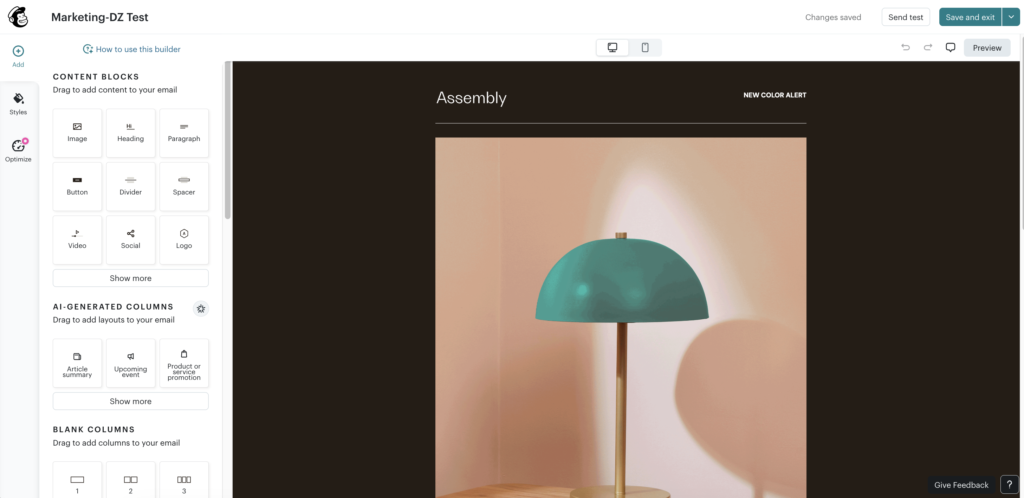
Unlike Brevo’s CRM-first positioning, Mailchimp has historically evolved as a campaign-centric marketing platform. Its core strength remains email campaigns and audience-based marketing, with features designed to optimize creation, delivery, and performance of newsletters and promotional flows.
Mailchimp’s approach centers around audiences, segments, and tags, rather than a fully fledged CRM model. This structure works well for teams focused on recurring campaigns, ecommerce promotions, and list-based marketing, but can feel limiting for lifecycle-driven or sales-oriented workflows.
Over time, Mailchimp has expanded into areas such as landing pages, basic automation, and ecommerce integrations. However, these additions reinforce its role as a marketing execution platform, rather than a system of record for customer relationships.
In practice, this explains why Mailchimp excels in ease of campaign creation and ecosystem integrations, while relying more heavily on external tools for CRM, deal management, or advanced sales workflows.
How this impacts day-to-day usage
Mailchimp’s campaign-first design favors:
- Fast setup for newsletters and promotions
- Strong e-commerce and CMS integrations
- Clear reporting on campaign performance
However, managing contacts across longer lifecycles or coordinating sales and marketing activities typically requires additional tools or workarounds.
Ease of Use & Learning Curve
Ease of use is often underestimated in tool comparisons, yet it has a direct impact on adoption, consistency, and long-term ROI. Both Brevo and Mailchimp are easy to use, but they achieve that ease in different ways.
Mailchimp: highly guided, campaign-oriented UX
Mailchimp is designed to minimize friction for users who want to launch campaigns quickly and easily. Its interface is highly guided, with prompts, defaults, and predefined paths that reduce decision-making.
Key strengths include:
- Polished drag-and-drop email editor
- Clear campaign setup flows
- Strong onboarding for first-time users
- Minimal configuration required upfront
This makes Mailchimp especially accessible for beginners, solo creators, and e-commerce users running frequent promotional campaigns.
The trade-off is that this guidance can become restrictive as workflows grow more complex, particularly when managing contacts across longer lifecycles.
Brevo: easy to use, but more structurally flexible
Brevo is also easy to use, featuring a modern drag-and-drop email editor, as well as an extensive Help Center and documentation that cover campaigns, automation, and CRM features.
Where Brevo differs is in how much structure it exposes early on. Users are encouraged to think in terms of contacts, attributes, events, and workflows, rather than being guided step by step through predefined campaign paths.
Typical characteristics include:
- Slightly more setup decisions upfront
- Greater visibility into automation and contact logic
- Strong documentation to support self-guided learning
For many teams, this means Brevo feels straightforward for day-to-day use, while remaining flexible enough to support more advanced workflows without rework later.
| Aspect | Brevo | Mailchimp |
|---|---|---|
| Drag-and-drop email editor | Yes | Yes |
| Ease of basic campaign setup | Easy | Very easy |
| Guided onboarding | Moderate | High |
| Structural flexibility | High | Moderate |
| CRM & lifecycle concepts | Built-in | Limited |
| Help center & documentation | Extensive | Extensive |
| Interface languages | EN, FR, ES, DE, IT, PT | English-first |
| Multilingual team adoption | Strong | Moderate |
| Long-term scalability without rework | High | Moderate |
Which one feels easier in practice?
Mailchimp feels easier when you want guidance and defaults.
Brevo feels easier when you want control without complexity.
Both platforms are accessible to non-technical users. The difference lies less in usability and more in how opinionated the product is about how you should work.
Deliverability: Which One Performs Better in Practice?
Deliverability is one of the hardest areas to evaluate from the outside, yet it has a direct impact on open rates, sender reputation, and long-term performance. Both Brevo and Mailchimp invest heavily in infrastructure, but their approaches reflect different priorities.
Shared fundamentals
Both platforms provide the core deliverability requirements expected from established email service providers:
- Domain authentication (SPF, DKIM, DMARC)
- Bounce handling and suppression logic
- Compliance with major ISPs and anti-spam regulations
- Shared and dedicated sending infrastructure (plan-dependent)
At a baseline level, neither platform is inherently weak in terms of deliverability when properly configured.
Brevo: European infrastructure and volume-aware controls
Brevo is a French-based company operating under EU regulatory frameworks, including GDPR by design. Its infrastructure emphasizes:
- European data hosting options
- Clear separation between marketing and transactional traffic
- Volume-based reputation management
- Gradual warm-up and sender reputation controls
This setup tends to work well for organizations that send mixed transactional and marketing emails, operate across multiple domains, or require stronger alignment with EU data protection standards.
Advanced deliverability features — such as dedicated IPs, priority routing, or enhanced SLAs — are available on higher-tier plans, which is consistent with industry norms.
Mailchimp: US-based infrastructure with strong guardrails
Mailchimp is a US-based platform and operates under a different compliance model. While it supports GDPR-compliant usage through contractual safeguards, its infrastructure relies more heavily on strict platform-wide enforcement to protect sender reputation.
From a deliverability standpoint, Mailchimp prioritizes:
- Conservative sending thresholds on shared IPs
- Automated enforcement around audience hygiene
- Strict content and compliance policies
These guardrails tend to benefit small to mid-size senders, helping maintain stable inbox placement with minimal configuration, though they can feel restrictive for advanced or high-volume use cases.
What actually impacts deliverability
In practice, deliverability outcomes depend less on the platform itself and more on:
- List hygiene
- Sending consistency
- Authentication setup
- Content quality
Between the two:
- Mailchimp often performs very well out of the box for smaller senders who benefit from firm defaults.
- Brevo tends to perform better at scale for teams managing higher volumes or more complex sending patterns.
Deliverability and infrastructure considerations in this section are consistent with independent evaluations published by platforms such as EmailTooltester, which emphasize sending behavior and reputation management over tooling alone.
Final Verdict: Which One Should You Choose in 2026?
There is no universal winner between Brevo and Mailchimp. The right choice depends on how you operate today and how you expect your marketing to evolve.
Both platforms are mature, reliable, and widely adopted — but they are optimized for different operating models.
Choose Brevo if you…
- Want an email marketing platform with a strong built-in CRM
- Manage large or growing contact lists with controlled sending volumes
- Combine marketing and transactional emails under one roof
- Operate in Europe or care about EU-based infrastructure and GDPR alignment
- Prefer flexibility over rigid, opinionated workflows
- Expect to scale automation and lifecycle management over time
Brevo makes more sense when email marketing is part of a broader customer system, not just a newsletter channel.
Free plan available (up to 300 emails/day). No credit card required.
Choose Mailchimp if you…
- Want to launch campaigns quickly with minimal setup
- Prioritize ease of use and guided workflows
- Run ecommerce-focused or promotion-heavy campaigns
- Have a small to mid-size list and value strong defaults
- Rely heavily on a large integration ecosystem
- Prefer guardrails that reduce risk without deep configuration
Mailchimp remains a strong choice for teams that value simplicity, speed, and predictability.
Bottom line
Mailchimp excels at getting started fast.
Brevo excels at growing without needing to rebuild later.
If your needs are primarily campaign-driven today, Mailchimp is often the most straightforward option.
If you’re thinking in terms of systems, lifecycle, and long-term scalability, Brevo tends to age better.